
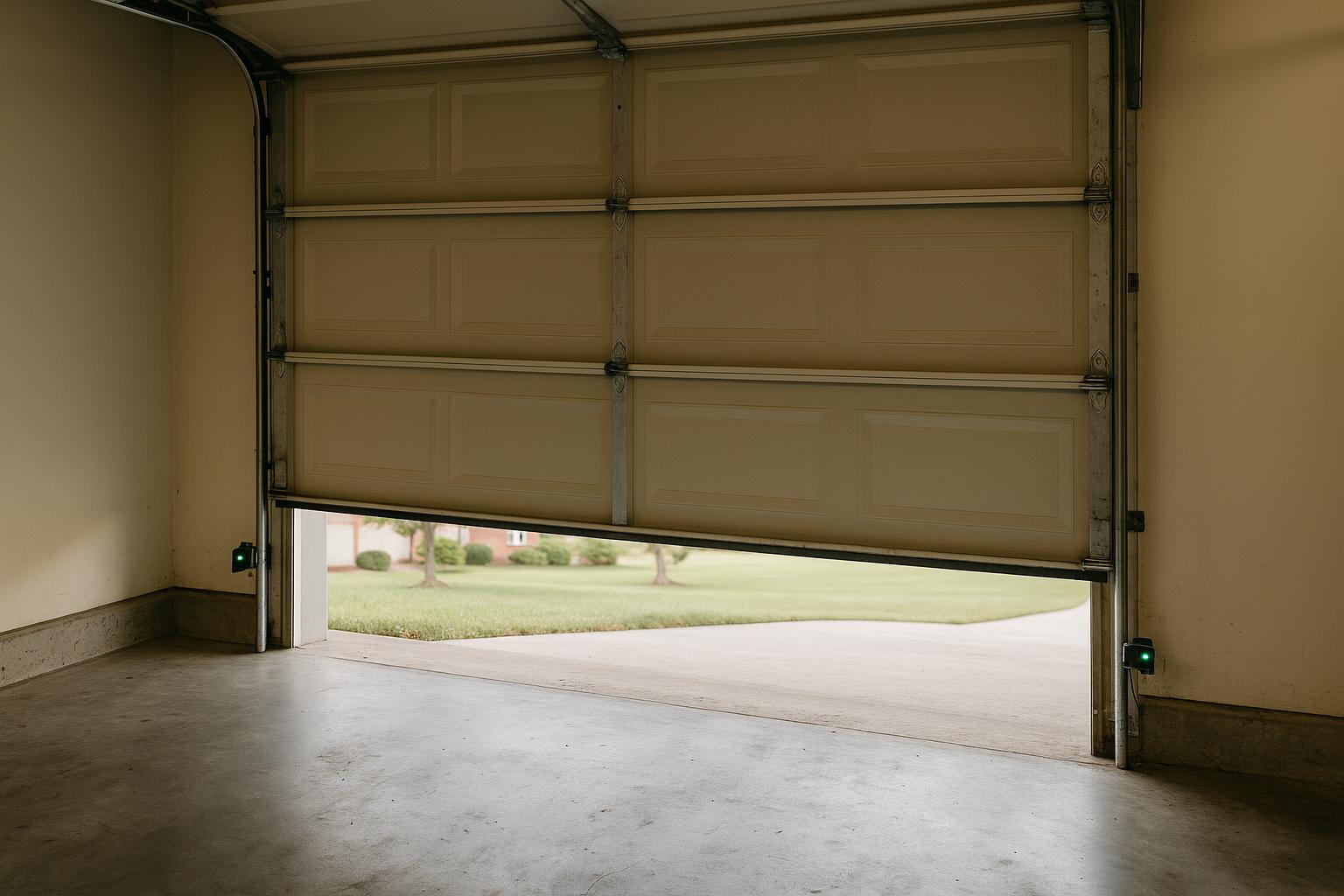
That Frustrating Moment When Your Garage Door Won't Stay Closed
You press the button on your remote, the garage door starts its descent, and then — right before it reaches the floor — it reverses and goes back up. You try again. Same thing. Maybe it works on the third attempt, maybe it doesn't. Either way, you're standing in your driveway in Clarksville wondering what just happened.
This is one of the most common garage door problems we see, and it's also one of the most misunderstood. Homeowners often assume the motor is dying or the door itself is broken, but the real cause is usually much simpler — and sometimes it's a fix you can handle yourself.
Let's walk through the most likely reasons your garage door reverses before hitting the floor and what you can do about each one.
The Safety Sensors Are Misaligned or Blocked
This is the number one cause of a garage door that reverses before closing, and it accounts for the majority of service calls we get for this issue.
Every garage door opener manufactured after 1993 is required to have photo-eye safety sensors installed near the bottom of the door tracks, about six inches off the ground. These sensors send an invisible beam across the opening. If anything breaks that beam — a bike, a trash can, a leaf, even a cobweb — the opener interprets it as an obstruction and reverses the door to prevent injury or damage.
Here's what to check:
- Look for obstructions. Move anything that might be blocking the sensor's line of sight, even partially.
- Check the sensor lights. Most sensors have small LED indicator lights. If one is blinking or off entirely, that sensor may be misaligned or receiving no power.
- Clean the lenses. Dust, dirt, and spider webs accumulate on sensor lenses quickly, especially during Tennessee's humid summers. Wipe them gently with a soft cloth.
- Check alignment. If a sensor has been bumped — maybe by a lawnmower or a kid's bicycle — it may no longer point directly at the other sensor. Carefully adjust it until both indicator lights show a steady glow.
If you've tried all of this and the sensors still won't cooperate, the wiring may be damaged or the sensors themselves may need replacement. That's when it's time to call a professional.
The Close-Limit Switch Needs Adjustment
Your garage door opener has a setting called the close-limit switch (sometimes called the travel limit). This tells the motor how far the door needs to travel before it's considered fully closed. If this setting is off — even by a small amount — the opener may think the door has hit something when it's actually just reaching the floor.
When the opener senses unexpected resistance at the bottom of travel, it treats it the same as hitting an obstruction and reverses the door.
On most openers, you'll find the limit adjustment screws on the back or side of the motor unit. They're usually labeled "open" and "close" with small arrows. Turning the close-limit screw slightly can extend the travel distance and solve the problem.
A word of caution: Adjusting the travel limits incorrectly can cause the door to press too hard against the floor, which puts stress on the tracks, rollers, and the opener itself. If you're not comfortable making this adjustment, it's better to have a technician handle it.
The Tracks Are Dirty or Damaged
Your garage door rides along metal tracks on both sides. Over time, these tracks can accumulate dirt, grease buildup, or even small debris. If the rollers encounter enough resistance as the door travels downward, the opener may interpret that friction as an obstruction and reverse.
Inspect the tracks visually. Look for:
- Visible dirt or grime buildup
- Dents or bends in the track
- Sections where the track has shifted away from the wall
You can clean the tracks with a damp cloth and a mild household cleaner. Avoid using WD-40 or heavy lubricants directly on the tracks, as this can attract more dirt. If you notice bends or dents, don't try to hammer them out yourself — a misaligned track can cause the door to come off its tracks entirely, which is a serious safety hazard.
The Force Settings Are Too Sensitive
In addition to travel limits, most garage door openers have force settings that control how much resistance the motor will push through before reversing. If the downward force is set too low, the door may reverse from even minor resistance — like the weatherstripping at the bottom of the door compressing against the garage floor.
This is especially common after a new garage door installation or when weatherstripping has been replaced. The slightly different resistance profile can trigger the opener's safety mechanism.
Like the travel limits, force adjustments are typically controlled by screws or dials on the opener unit. Small, incremental adjustments are key here. You want the door to close firmly but not so forcefully that it could injure someone or damage property.
Worn or Broken Springs Can Contribute
While broken springs more commonly prevent a door from opening at all, worn springs that have lost tension can also cause closing problems. When the springs aren't properly counterbalancing the weight of the door, the opener has to work much harder. That extra strain can trigger the force-reversal safety feature.
If your door feels noticeably heavier when you try to lift it manually, or if it doesn't stay in place when you open it halfway and let go, your springs may be wearing out. Spring replacement is not a DIY job — these components are under extreme tension and can cause serious injury if handled incorrectly. This is one repair you should always leave to a trained technician.
When to Call a Professional in Clarksville
Some of the fixes above — cleaning sensors, clearing obstructions, wiping down tracks — are perfectly safe for homeowners to tackle. But if you've gone through the basics and your garage door is still reversing, or if the problem involves springs, tracks, or opener adjustments you're not confident about, it's time to bring in help.
At Clarksville Overhead Door Co, we troubleshoot these kinds of issues every week for homeowners across Clarksville, Fort Campbell, Springfield, and the surrounding areas. We'll diagnose the actual cause, explain your options, and get the door working properly — usually in a single visit.
Don't Ignore a Reversing Garage Door
It might seem like a minor annoyance, but a garage door that won't close properly is a security risk. It leaves your home, your vehicles, and your belongings exposed. It can also signal a developing mechanical problem that will get more expensive to fix the longer you wait.
If your garage door is giving you trouble, give us a call. We'll show up when we say we will and get it sorted out.